

You will open a double-dwell cam, read its displacement, velocity, acceleration and jerk (the SVAJ diagrams) and see why the choice of motion law matters, using the fundamental law of cam design.
1. Open CamLab
Open CamLab and click New in the top bar. Check that the units, beside Examples…, are SI (mm, N, kg).
2. Read the motion program
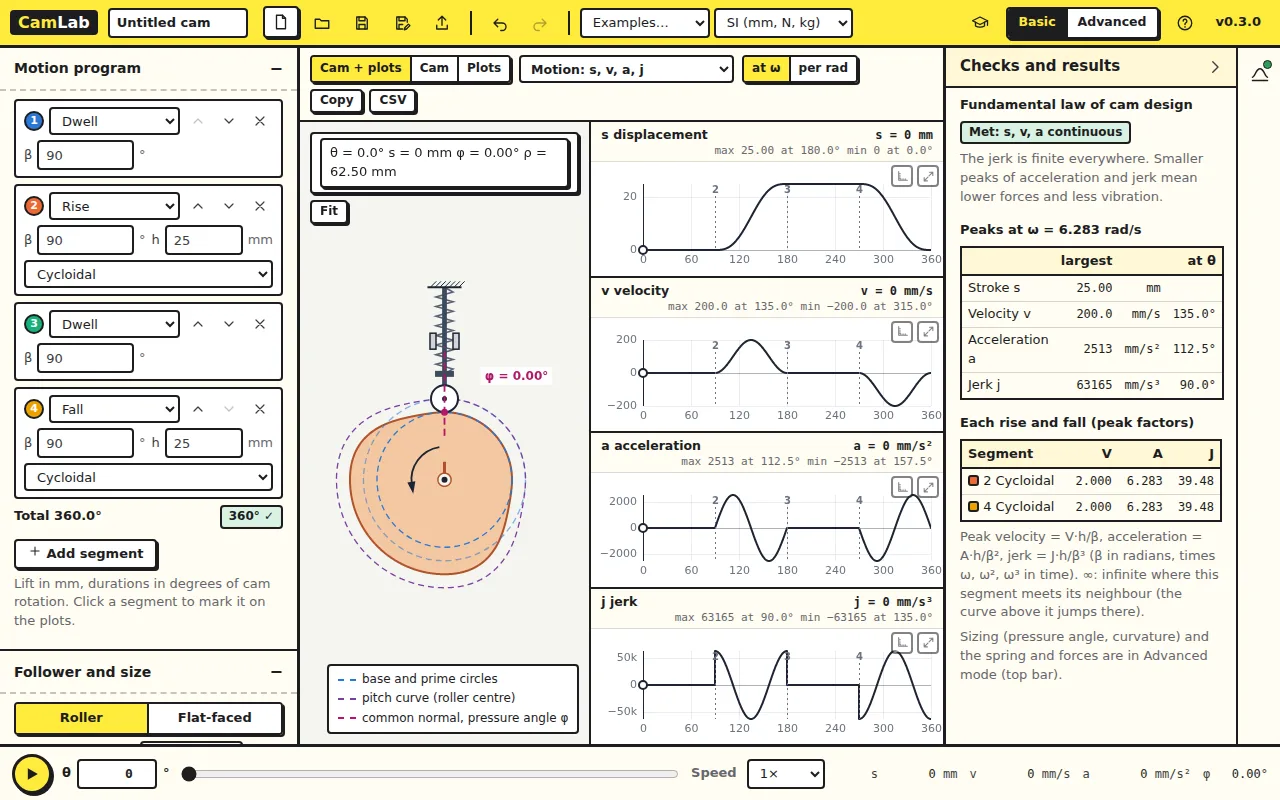
A new design is a double-dwell cam. The Motion program on the left lists its four segments, in degrees of cam rotation:
| Segment | What the follower does |
|---|---|
| 1 Dwell, 90° | stays down |
| 2 Rise, 90°, h = 25 mm, Cycloidal | rises 25 mm |
| 3 Dwell, 90° | stays up |
| 4 Fall, 90°, h = 25 mm, Cycloidal | comes back down |
The total must be 360°; the green tag under the list confirms it. The cam turns at ω = 6.283 rad/s (60 rpm), under Speed on the left.
3. Read the SVAJ diagrams
The four plots show s, v, a and j over one turn of the cam. The dotted lines numbered 2, 3 and 4 are where each segment starts. Type an angle in the θ box at the bottom, or drag the slider beside it, to turn the cam.
Under Checks and results, the Fundamental law of cam design says Met: displacement, velocity and acceleration are continuous, so the jerk is finite everywhere.
Check your numbers
For a cycloidal rise the peaks are V = 2h/β, A = 2πh/β² and J = 4π²h/β³ (per radian of cam angle, with β in radians), times ω, ω² and ω³ for time. With h = 25 mm, β = π/2 and ω = 2π rad/s:
| Peak | By hand | CamLab |
|---|---|---|
| Velocity | 2 · 25 / (π/2) · 2π | 200.0 mm/s |
| Acceleration | 2π · 25 / (π/2)² · (2π)² | 2513 mm/s² |
| Jerk | 4π² · 25 / (π/2)³ · (2π)³ | 63165 mm/s³ |
4. Change the motion law
In segment 2, change Cycloidal to Simple harmonic. Do the same in segment 4.
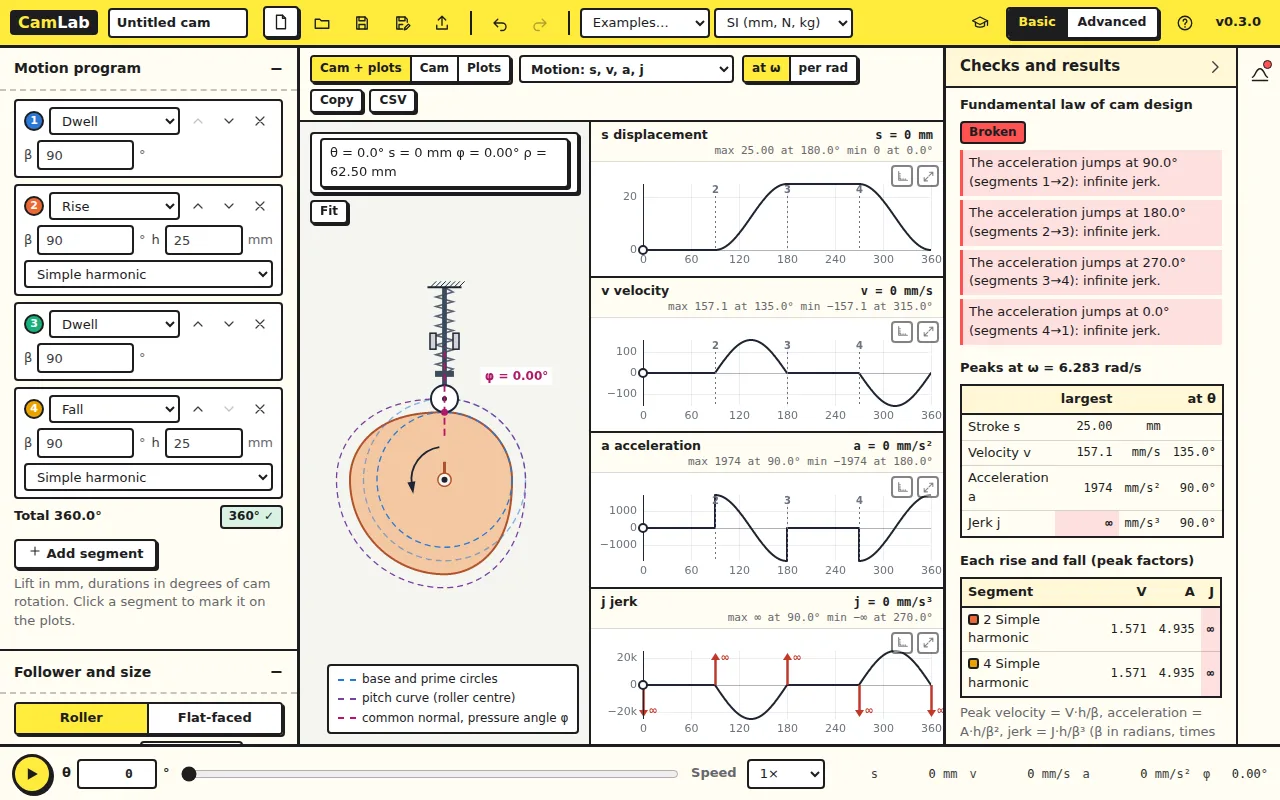
The peak velocity and acceleration go down (157.1 mm/s and 1974 mm/s²), but the fundamental law now reads Broken. The acceleration jumps where each rise or fall meets a dwell, so the jerk is infinite there: the red arrows on the jerk plot. A real cam would hit the follower at those points, four times a turn.
This is the main lesson of cam design: a smaller peak is not better if the motion is not smooth.
Try this
Change segments 2 and 4 to 3-4-5 polynomial. Is the fundamental law met? How do the peaks compare with cycloidal motion?
Answer
The law is met: s, v and a are continuous. Peak velocity 187.5 mm/s and acceleration 2309 mm/s² are lower than cycloidal (200.0 and 2513), but the peak jerk is higher: 96000 mm/s³ against 63165. Both laws keep the jerk finite. Choosing a law is a trade-off between these peaks.