

The motion program fixes how the follower moves. The size of the cam decides whether it can deliver that motion smoothly. This lesson sets the prime circle.
Open CamLab, click New and switch to Advanced. Under Plots beside the cam choose Size: pressure angle, ρ.
1. Two numbers to watch
Pressure angle φ is the angle between the force the cam applies and the direction the follower moves. The larger it is, the more of the cam force pushes the follower sideways against its guide. CamLab's limit for a translating roller follower is ±35°: the dashed red lines on the pressure angle plot, and the size check warns beyond them.
Radius of curvature ρ of the pitch curve must stay larger than the roller radius Rf on a convex part, or the roller cannot follow the cam and the profile is undercut.
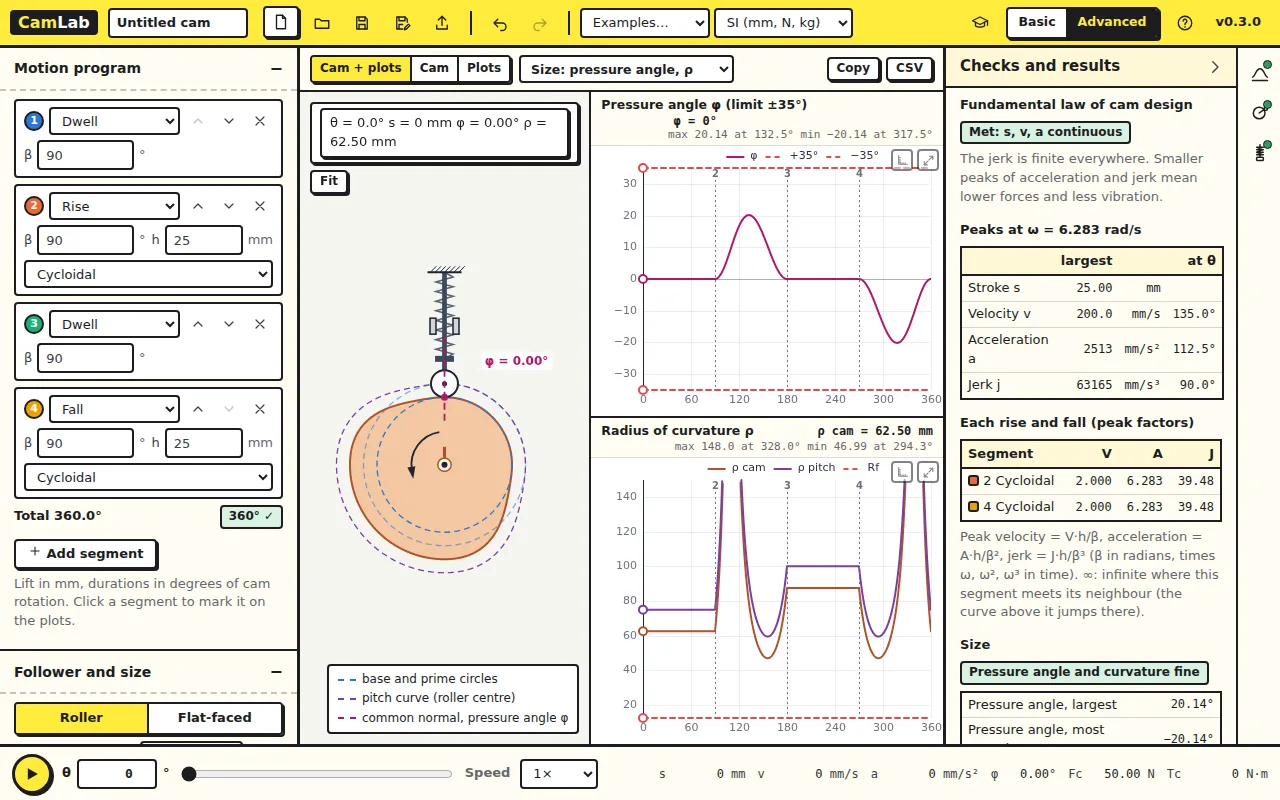
With the new design, Rp = 75 mm and Rf = 12.5 mm, Size under Checks and results reads Pressure angle and curvature fine:
| Rp = 75 mm | CamLab |
|---|---|
| Pressure angle, largest | 20.14° |
| ρ min, pitch curve (convex) | 59.49 mm |
| ρ min, cam surface (= ρ − Rf) | 46.99 mm |
Check your numbers
For a radial roller follower, tan φ = (ds/dθ − ε) / (s + √(Rp² − ε²)), with ε the eccentricity (zero here). The largest ds/dθ of a cycloidal rise is 2h/β = 31.8 mm/rad, at mid-rise where s = h/2 = 12.5 mm: tan φ = 31.8 / 87.5, φ = 20.0°. CamLab's 20.14° comes from the exact curve, where the peak is slightly off mid-rise.
2. A smaller cam
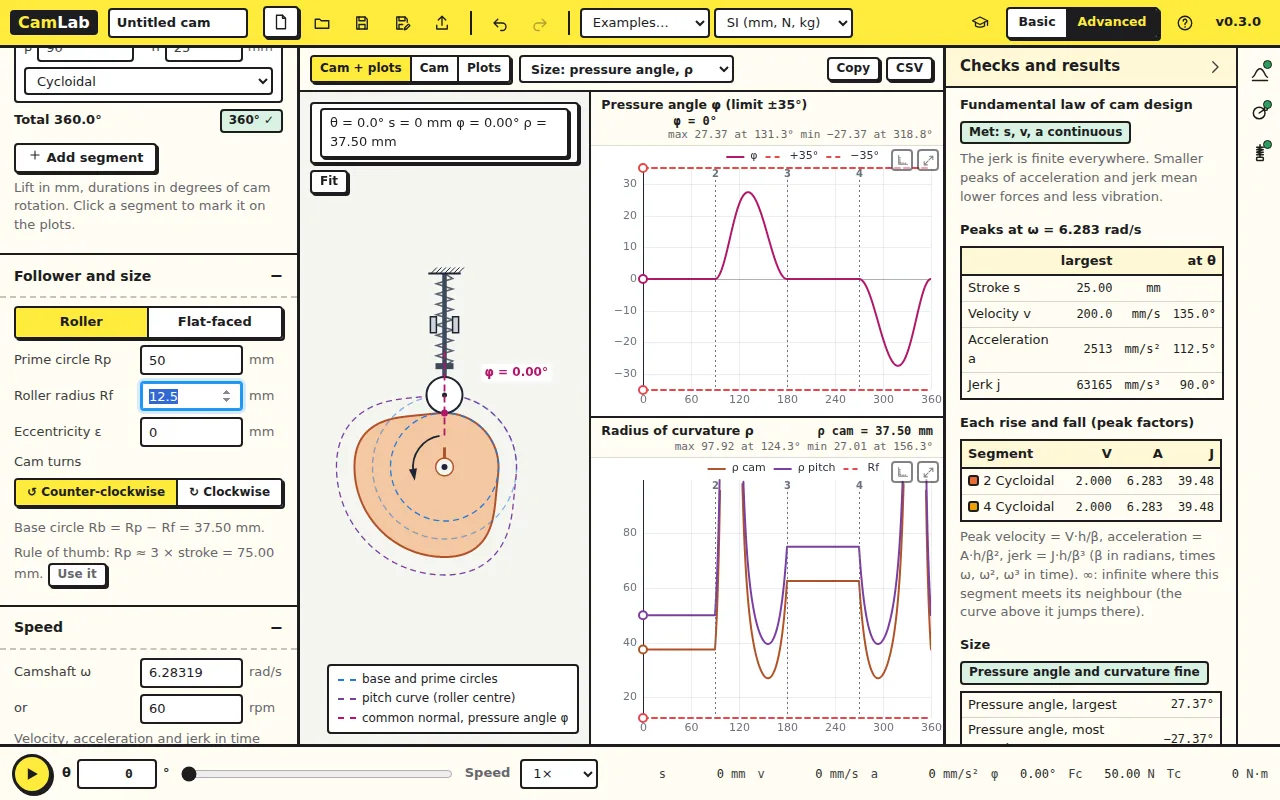
Set Prime circle Rp to 50 mm. The pressure angle rises to 27.37° and the cam surface's smallest radius of curvature drops to 27.01 mm. Still fine, but closer to the limits. The cam is 33% smaller.
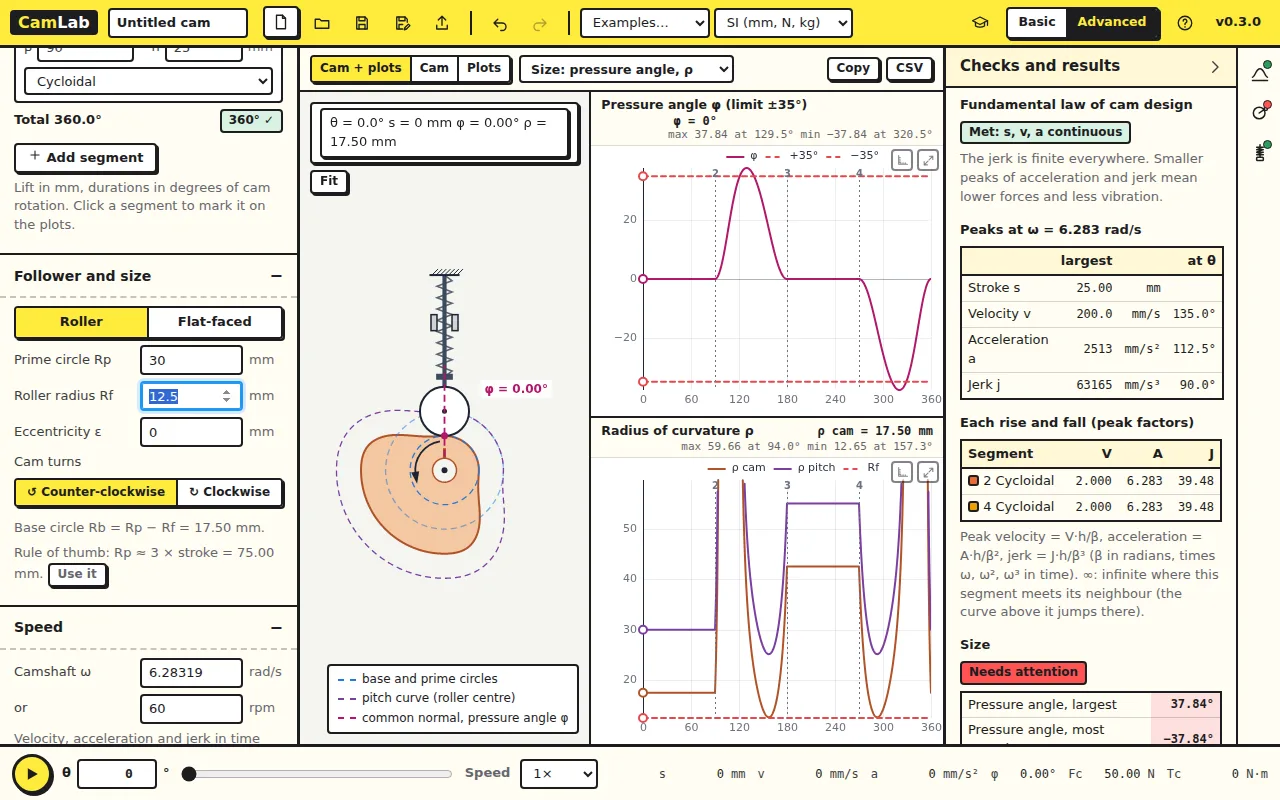
Now 30 mm: the pressure angle is 37.84° and the check reads Needs attention. Both plots show why: the pressure angle goes beyond the ±35° lines for about 18° in the middle of the rise (121° to 139°) and of the fall, and the surface radius has fallen to 12.65 mm, hardly larger than the roller.
The rule of thumb in the panel, Rp ≈ 3 × stroke, gives 75 mm for this 25 mm lift. It is a starting point, not a law: check both numbers.
Try this
Keep Rp = 30 mm and change the motion law of the rise and fall to Simple harmonic. Does the pressure angle improve? Why?
Answer
Yes: the largest pressure angle drops from 37.84° to 31.61°, inside the ±35° limit, and Size reads Pressure angle and curvature fine. Simple harmonic motion has a lower peak velocity (πh/2β against 2h/β for cycloidal, 21% less), and the pressure angle follows ds/dθ. But lesson 1 showed that simple harmonic breaks the fundamental law between a rise and a dwell. The honest fix for a large pressure angle is a larger cam, a longer rise (bigger β) or an offset follower, not a worse motion law.