

A cam can only push. A spring brings the follower back, and at speed the follower's inertia fights the spring. This lesson finds the speed at which the spring loses.
Open CamLab, click New, switch to Advanced, open Spring and follower mass on the left, and set Plots beside the cam to Forces: Fc, torque.
1. The cam force
The new design has a follower mass m = 1 kg, a spring rate k = 10 N/mm, a preload Fpl = 50 N and a damping ratio ζ = 0.06, at 60 rpm. The cam force is Fc = m·a + c·v + k·s + Fpl, with a and v in time (the acceleration and velocity per radian times ω² and ω).
| 60 rpm | CamLab |
|---|---|
| Damping c = 2ζ√(km) | 0.01200 N·s/mm |
| Natural frequency ωn | 100.0 rad/s |
| Cam force, largest | 300.0 N |
| Cam force, smallest | 50.00 N |
| Camshaft torque | −6.327 … 6.453 N·m |
At 60 rpm the inertia term is tiny: the force is the spring, 50 N at the bottom and 50 + 10 × 25 = 300 N at the top. Spring and forces reads Follower stays on the cam.
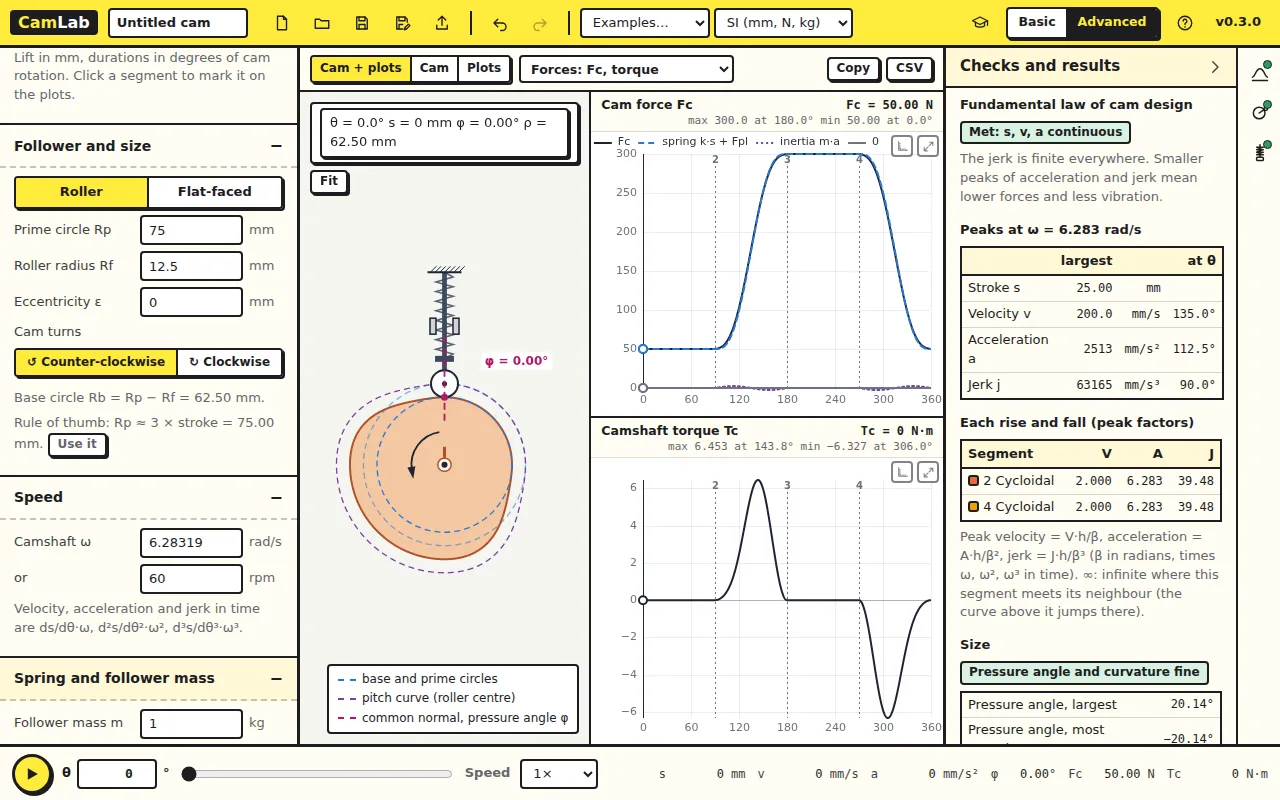
The torque plot goes negative on the fall: there the spring drives the cam. Over a cycle the torque averages to zero (no friction), but the peaks size the motor.
2. Faster
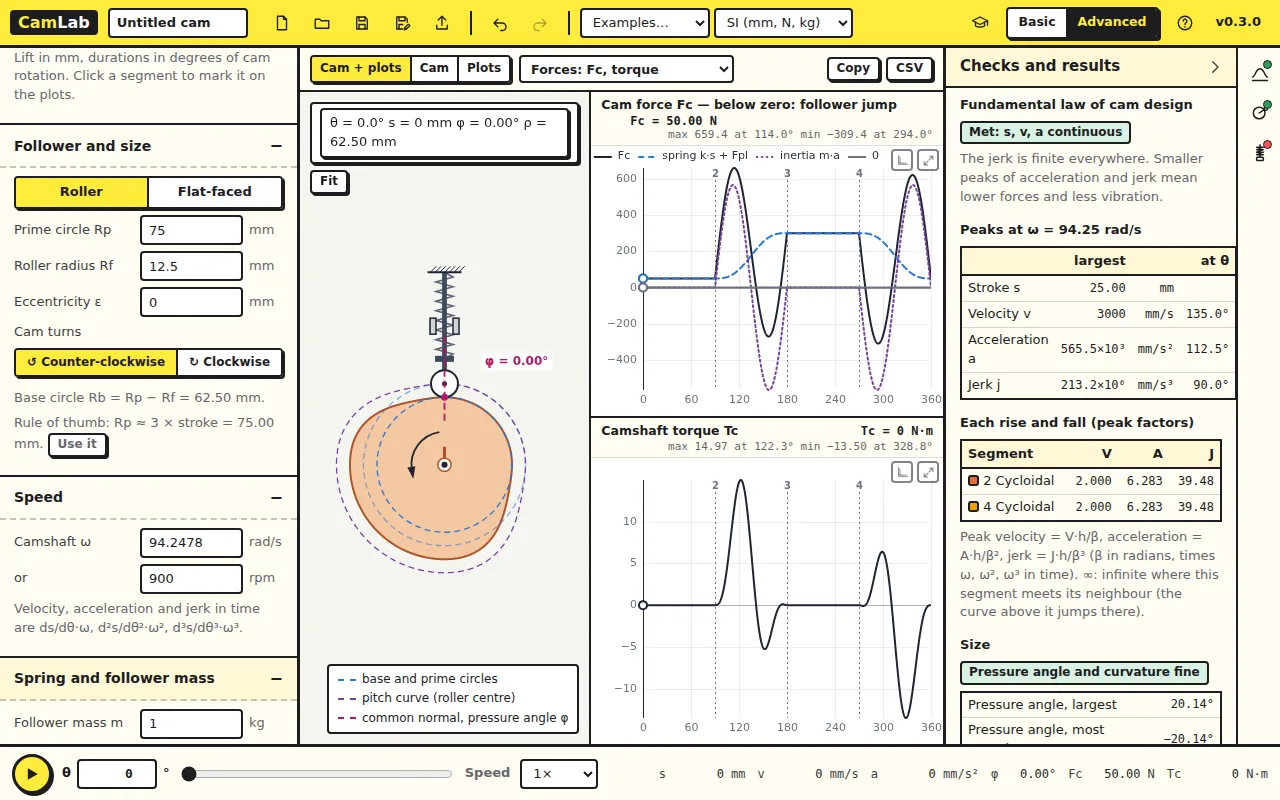
Set the speed to 600 rpm. The smallest cam force drops to 7.620 N, at 296°, early in the fall. There the follower is gathering speed downwards: its acceleration is large and negative, so its inertia pulls it away from the cam. Near the top of the rise (155.5°) the inertia pulls the same way, yet the force stays at 36.13 N. The difference is the damping force c·v: on the rise the cam also pushes against the damping (c·v adds to the force); on the fall the damping helps pull the follower down (c·v takes away from it).
At 900 rpm the smallest force is −309.4 N (at 294°; near the top of the rise it is −270.6 N), and the check reads Follower jump. A negative cam force is impossible: the cam cannot pull. The follower leaves the cam near the top of the rise and again early in the fall, and lands again later with an impact.
Check your numbers
The peak negative acceleration of a cycloidal rise is −2πh/β² per rad²: −63.7 mm/rad² here. At 900 rpm (ω = 94.2 rad/s) that is −565 m/s², so m·a = −565 N against the spring's 50 + 10 × 25 = 300 N (less, since the peak is not exactly at the top). Inertia wins.
Try this
Still at 900 rpm, raise the Preload until the follower stays on. How much is needed? What does it do to the largest cam force?
Answer
About 400 N: the smallest force is then 40.63 N. The price is the largest force, now 1009 N instead of 659.4 N, on the cam, the roller and the shaft bearings. The alternatives are a stiffer spring (same trade-off), a lighter follower, or a slower cam: jump grows with ω².