

Kinematics tells you how the mechanism moves. This lesson asks what it takes to move it: the force at each pin and the torque at the motor.
Start from fourbar.linklab.json (lesson 1's fourbar). Switch to Advanced in the top bar and open the Forces tab. Set θ₂ to 60.
1. Held still
Click Static. LinkLab gives every link a mass from its shape: steel, 6 × 12 mm bars, and a plate for the coupler. The Masses table lists m and I_G for each link. The motor holds the mechanism still against gravity.
| At θ₂ = 60°, held still | LinkLab |
|---|---|
| Motor torque T₁₂ | 0.01927 N·m |
| F₁₂ (ground on crank, at J1) | 0.6183 N at 122.8° |
| F₁₄ (ground on rocker, at J2) | 1.021 N at 70.8° |
Click the coupler on the drawing. Its free-body diagram appears: the two pin forces and its weight. They sum to zero, as they must for a link held still. The same for the crank, with the motor torque added.
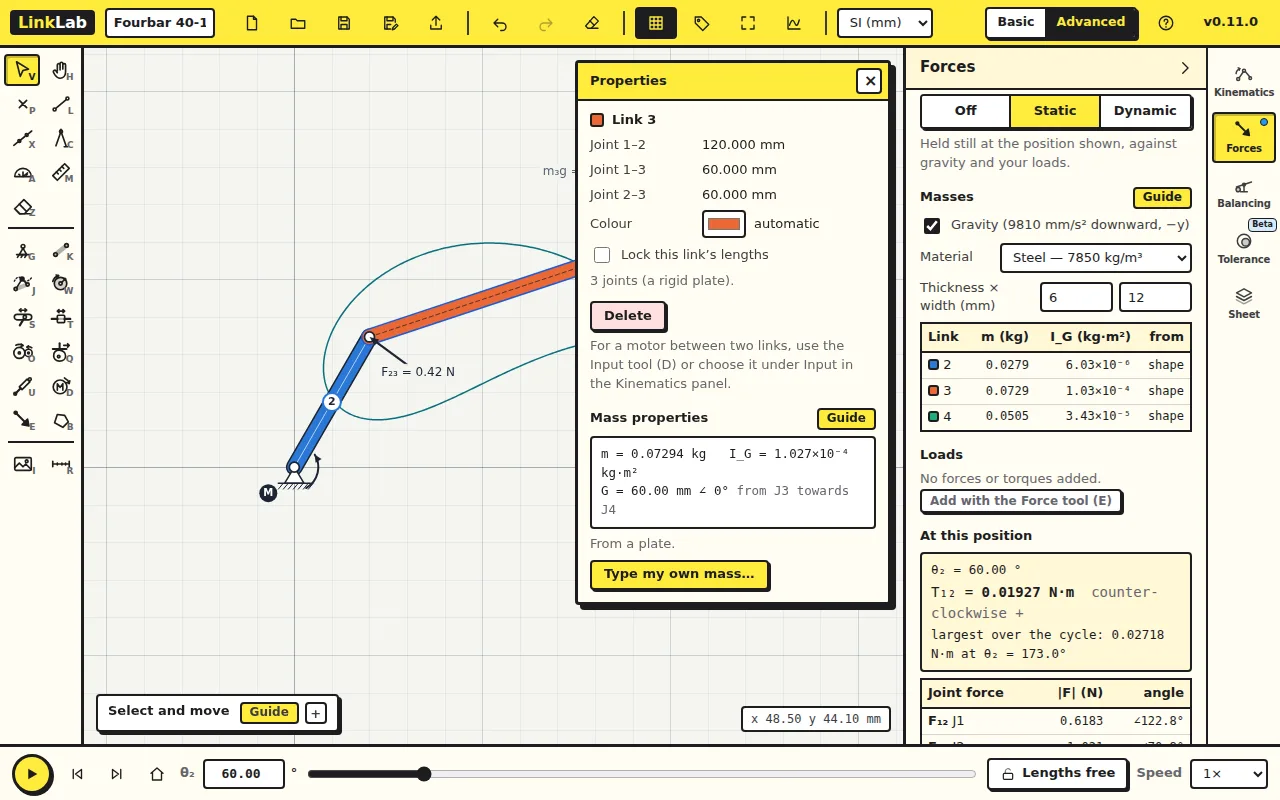
The name F₁₂ follows the usual textbook convention: the force of link 1 on link 2. F₂₁ is the same force the other way round.
2. At speed
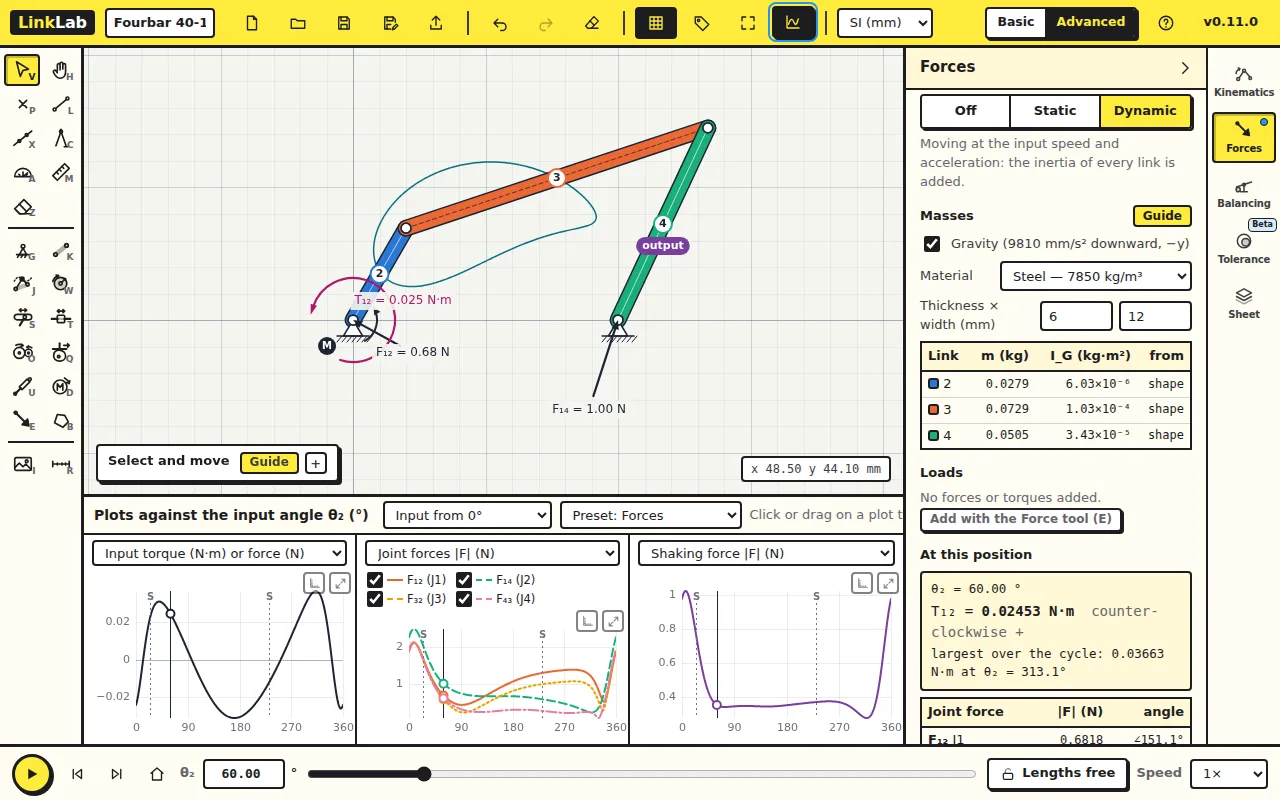
Click Dynamic. The input turns at ω₂ = 10 rad/s, and each link now has an inertia force −m·a_G and an inertia couple −I·α as well.
| At θ₂ = 60°, ω₂ = 10 rad/s | LinkLab |
|---|---|
| Motor torque T₁₂ | 0.02453 N·m |
| Largest torque over the cycle | 0.03663 N·m at θ₂ = 313.1° |
| F₁₄ at J2 | 1.003 N at 72.0° |
| Largest joint force over the cycle | F₁₄ = 2.487 N at θ₂ = 8.9° |
| Shaking force on the frame | 0.351 N |
The Largest over the cycle table shows where each pin force peaks. Click a row to go to that position.
Click Plots and choose the preset Forces: the motor torque, the joint forces and the shaking force over the cycle.
Check your numbers
Write the three equations of motion for each link (ΣF = m·a_G, ΣM_G = I·α) with the accelerations from lesson 2, and solve the nine equations for the eight pin-force components and T₁₂. The static case is the same with every acceleration set to zero.
Try this
In the Kinematics panel, set ω₂ to 30 rad/s (press Tab), then look at the Forces tab again. How much does the largest motor torque grow? Which pin now carries the largest force?
Answer
The largest torque goes from 0.0366 to 0.268 N·m, about 7.3 times, and the largest pin force from 2.49 to 15.0 N, now F₁₂ at the crank pivot J1. Inertia forces grow with ω², so tripling the speed would give nine times the inertia forces; gravity, which does not grow, dilutes that a little. At speed, the crank pivot takes the most.