

A mechanism shakes its frame when its total centre of mass moves. This lesson stops that movement with two counterweights.
Start from fourbar.linklab.json. Switch to Advanced, set the Forces tab to Dynamic, then open the Balancing tab.
1. The total centre of mass
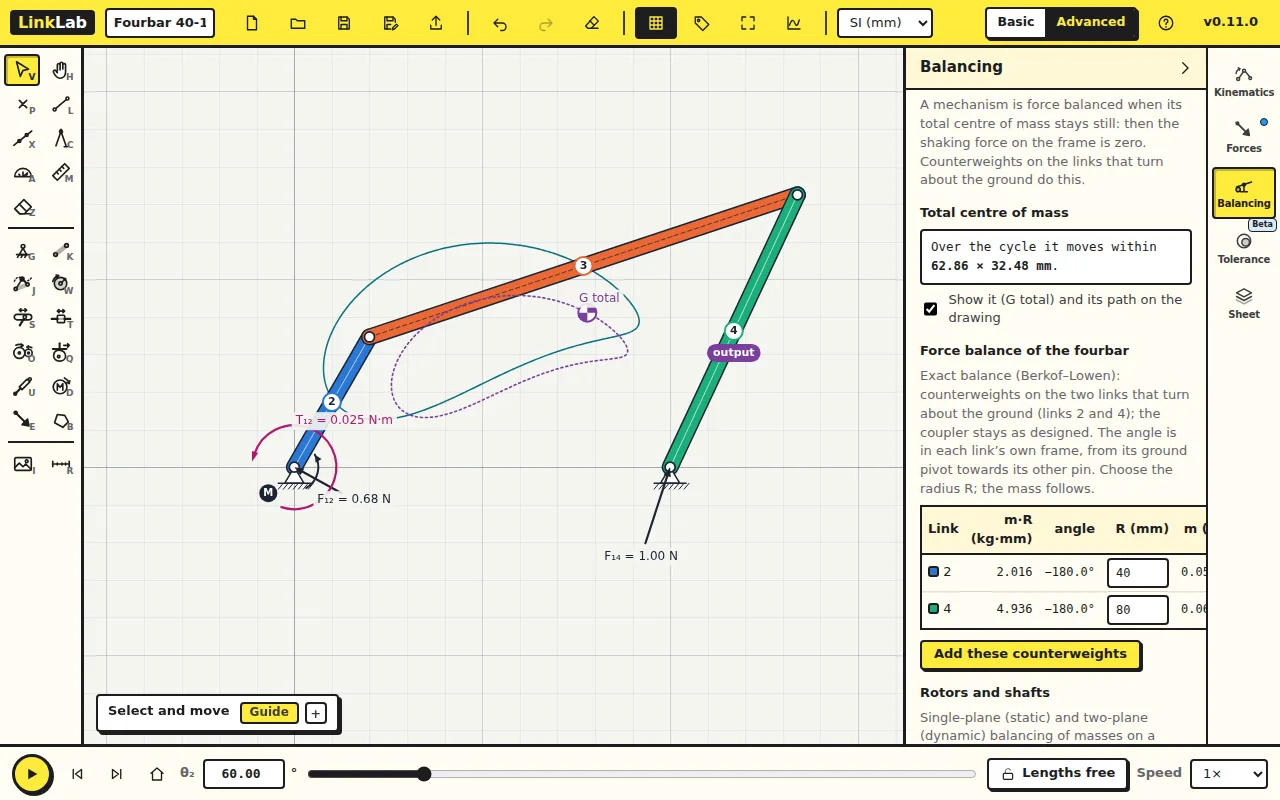
Tick Show it (G total). A marker and its path appear on the drawing: over the cycle, G total moves within 62.86 × 32.48 mm. The shaking force on the frame is the total mass times the acceleration of this point.
2. The counterweights
The table under Force balance of the fourbar gives the counterweights that hold G total still: on the crank and on the rocker, each measured in the link's own frame from its ground pivot.
| Link | m·R | angle |
|---|---|---|
| 2 (crank) | 2.016 kg·mm | 180° |
| 4 (rocker) | 4.936 kg·mm | 180° |
Both sit directly opposite the link's other pin. Type a radius R of 20 mm for each and the mass follows: 0.1008 kg on the crank and 0.2468 kg on the rocker. Click Add these counterweights.
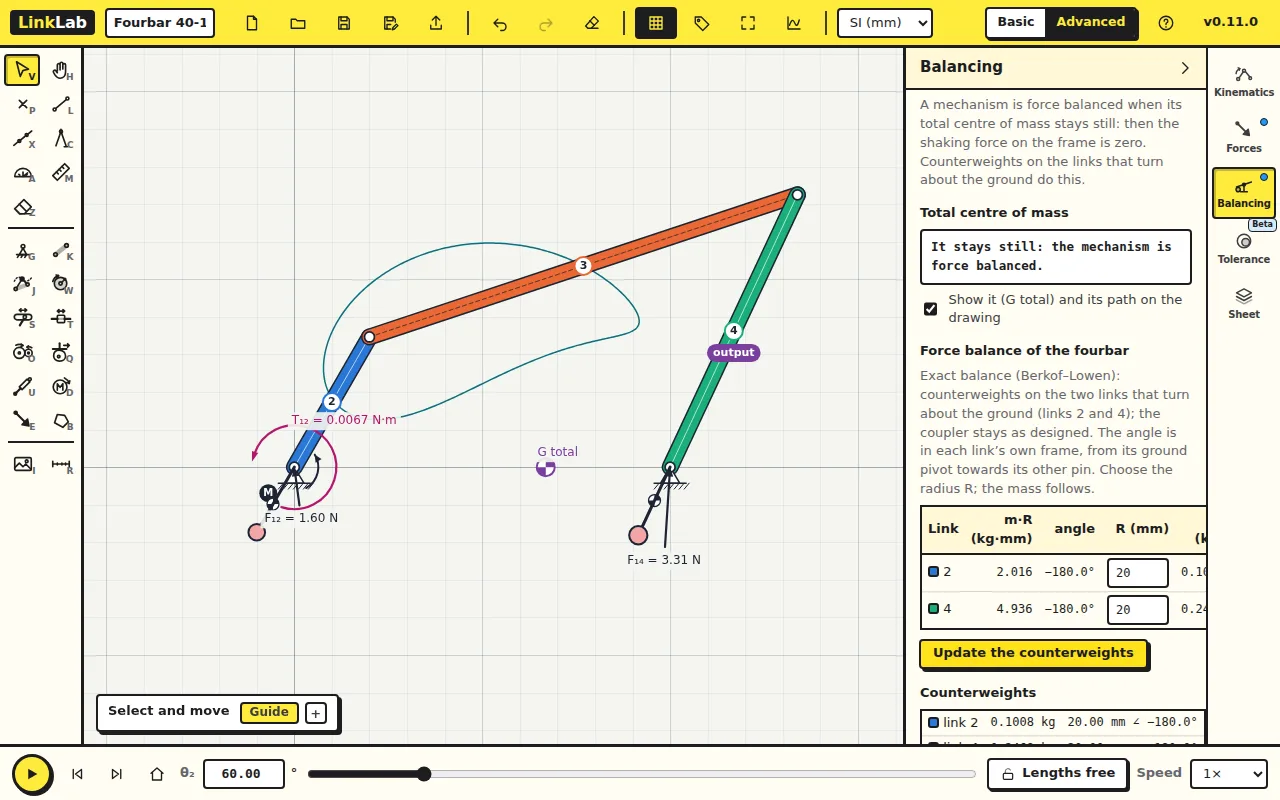
The panel now reads "It stays still: the mechanism is force balanced."
Check your numbers
This is the Berkof–Lowen method. With the coupler's centre of mass at distance b₃ from A along AB, the crank needs m₂b₂e^(jφ₂) = m₃(a/b)(b₃e^(jφ₃) − b) in total, and the rocker m₄b₄e^(jφ₄) = −m₃(c/b)b₃e^(jφ₃). Subtract what the bare links already have (their own mass at mid-length) to get the counterweights above.
3. What balancing costs
The table Without and with the counterweights compares the two:
| Largest over the cycle | without | with |
|---|---|---|
| Shaking force | 1.022 N | 0 |
| Shaking moment | 0.0856 N·m | 0.0630 N·m |
| Motor torque | 0.0366 N·m | 0.0402 N·m |
| Joint force | 2.49 N | 4.53 N |
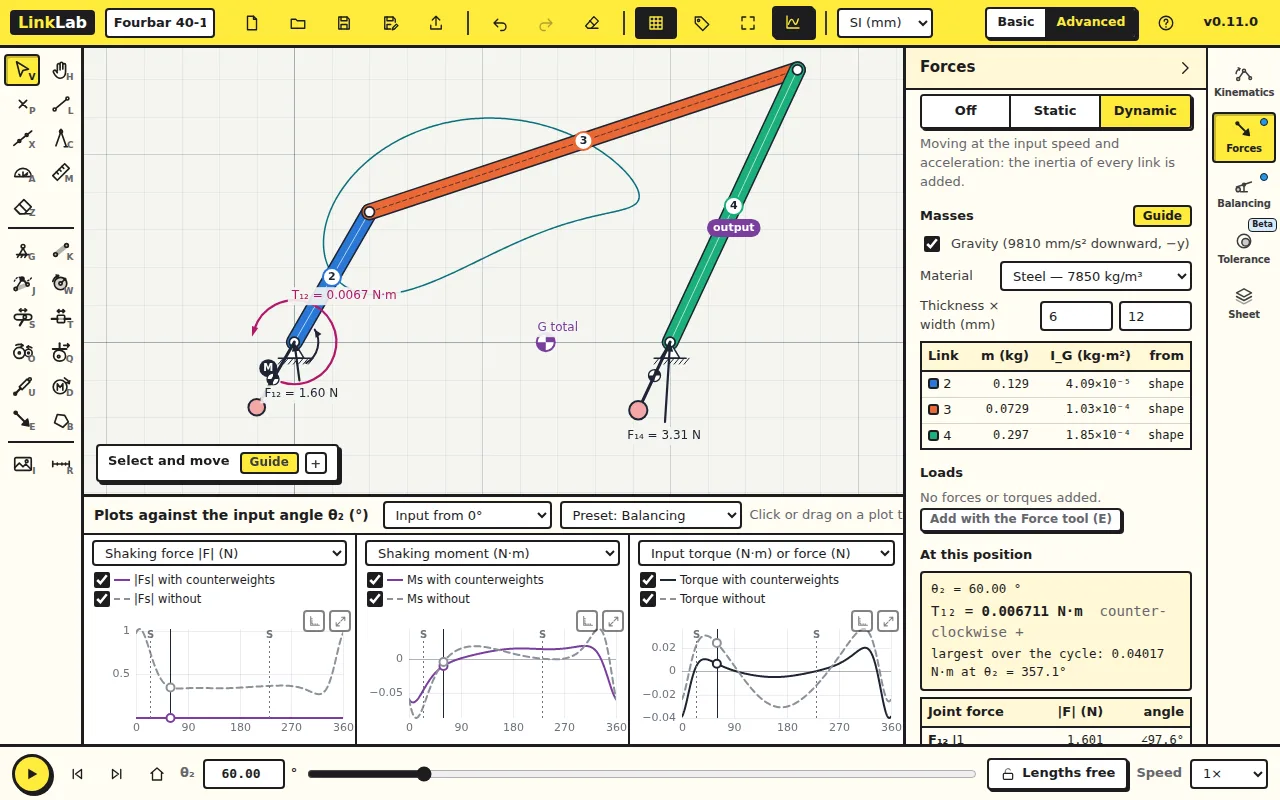
The shaking force is gone. The price is 10% more motor torque and 82% more pin force, because the counterweights add mass that has to be accelerated too. The shaking moment is reduced but not removed: force balancing cannot do that.
The Balancing preset in the plots shows the shaking force, the shaking moment and the motor torque over the cycle. Untick Use the counterweights to compare.
Try this
Set R to 40 mm instead of 20 mm. What changes?
Answer
The masses halve (m·R stays the same: 0.0504 and 0.1234 kg) and the mechanism is still balanced. The largest joint force comes down, from 4.53 to 3.83 N, because less mass is being swung round. But the largest motor torque goes up, from 0.040 to 0.050 N·m: a mass further from the pivot has more moment of inertia (m·R²), and the motor has to accelerate it. The radius is a trade-off between pin load, torque and the room round the pivot.